7 ways to fight for and protect trans youth

It is hard to overstate how hard it is to be a trans person right now. Our rights and our lives are literally up for debate across the United States, and with the U.S. presidential primary just around the corner, we aren’t likely getting a break any time soon. This newest moral panic about trans youth in sports, school bathrooms, and clinics has brought into question access to medical care for trans adults, threatening anyone who supports trans youth autonomy, including doctors, parents, and teachers. Once-reliable news sources such as the New York Times have leaned into the political “controversy,” leaving trans youth with few places to turn to for support that their experiences are valid and that they should have the right to the evidence-based treatment they are seeking.

In a time that feels devastatingly bleak, I wanted to offer some ways to engage with this issue. It can feel overwhelming and numbing to be in this hostile landscape, and I find that the typical suggestions of donating money or sharing within the echo chamber of social media are not enough to abate the overwhelm. This must be a community effort, and we must tap into the deep, generative parts of ourselves to make our movement – our lives – shine brightly enough to reach one another and to fight back.

1. Support youth-led organizing.

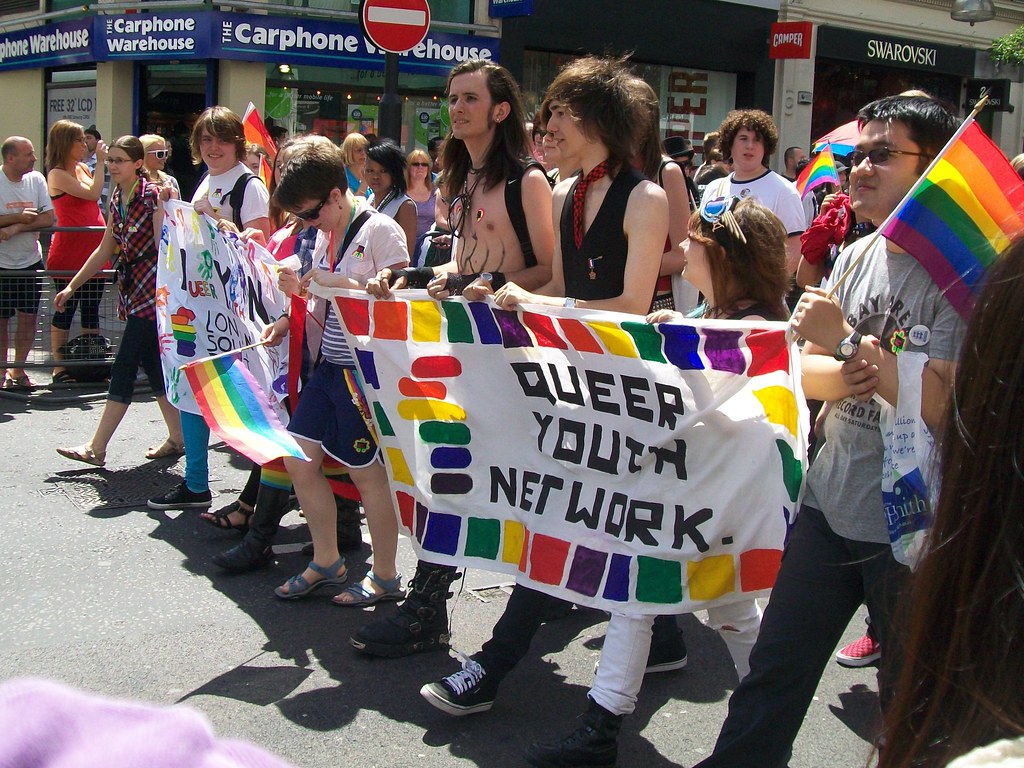
2017.02.24 Dance Protest Celebrating Trans Youth, Washington, DC USA 01168” by tedeytan is licensed under CC BY-SA 2.0. “March for Queer and Trans Autonomy” by Queer Youth Assemble.Queer Youth Network” by Peter O’Connor aka anemoneprojectors is licensed under CC BY-SA 2.0.

No one is more targeted right now than transgender youth, and they are not standing idly by. As one example, today is the National March for Queer & Trans Youth Autonomy, an event that spans all 50 states and Washington, D.C. Students are walking out of schools and into the streets with a list of demands that is a beautiful reminder that we should not just be demanding basic decency, but true liberation and autonomy. Queer Youth Assemble is just one of many youth-led organizations fighting for trans rights. If you’re an adult over 25, like me, then follow these organizations’ lead on what is needed and requested as accomplices in supporting their fight for justice. (If you’re a youth, get out there to organize and let us know how we can help!)

2. Join a school board.

Nationwide, queer and trans people and their advocates are hugely underrepresented in school boards. A recent survey by the Victory Institute found that only 0.1% of school board representatives nationwide were openly members of the LGBTQIA community, and that within that group, most were cisgender. A huge portion of the discourse happening around trans youth are focused on what happens inside of school systems. Part of the success of alt-right and extremist anti-trans “activists” has been leveraging culture wars and stirring up political pressure among large swaths of parents and community members, alongside effective bids for school board seats. Queer and trans people and those who support us must organize and take up more space in school governance to fight back on this trend. Here is one basic guide to running for school board, and most states have extensive information available on their webpage. There are many other ways to get involved in educational decision-making in your area, including participating in a parent-teacher association (PTA), attending and voicing your position in school board meetings, or getting involved in the campaign of a progressive candidate.

3. Sponsor a read-a-thon.
Image source: https://i.ytimg.com/vi/PmOJEVVnmm0/mqdefault.jpg, “paula reading a book” by Mario A. P. is licensed under CC BY-SA 2.0.

A few weeks ago, young adult author Sim Kern make a call on Tik Tok for a Trans Rights Read-a-Thon. While the national event happened earlier this March, it’s never too late to start an event rooted in the deliciously slow medium of reading a book. What’s beautiful about a Read-a-Thon is how many ways it supports the community – it boosts the work of transgender and nonbinary authors in libraries and bookstores, it provides mutual support and education about trans identity and experiences, and it can also be a tool for fundraising, if that’s your jam. Some excellent places you can raise money for by reading chapters or books include  Trans Health Legal FundPoint of Pride, or Trans Lifeline – or better yet, find a community organization in your local area that could use support! There are many excellent lists of books by trans and enby authors – here’s one for young adult novels, fiction/memoir, and non-fiction. As a science teacher, I’m also going to include this short list of books about science connected to gender and sexuality, one of which is written by a trans author.

4. Make and take in art.

Art is a powerful force. Whether a slogan embroidered onto a jean jacket, a protest song chanted at a rally, or a graffiti mural demanding justice, art has an important role to play in bringing about change. Creating art nourishes us and makes connections across time and space. Appreciating and sharing art can have a huge impact on yourself and others, and art is one way we can support one another through this difficult time. Take some time to create or appreciate art that supports trans autonomy and freedom, and support trans and nonbinary artists when you can by purchasing their work. Here are some of my favorite pieces by trans and nonbinary artists right now that are giving me life:

This video features Wendi CooperJennicet GutiérrezTiommi LuckettSean Saifa Wall, and Tatiana Williams reflecting on what liberation means to them. This video is a part of a series created by the Transgender Law Center that includes other visually stunning stories of affirmation and liberation.

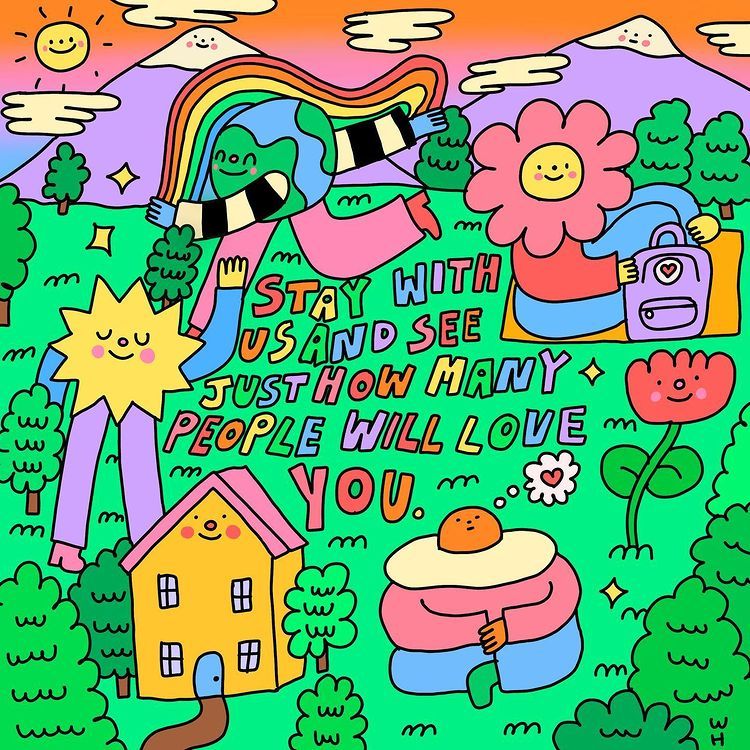
Art credits: LJ Roberts, “Portraits”Micah Bazant, “No Pride in War”Wednesday Holmes, “You haven’t even met all of the people that will love you.”

5. Become a teacher, mentor, or coach.

Trans youth need supportive adults in their lives. Whether you are a part of the LGBTQIA community yourself or simply someone who can offer an affirming presence, being a supportive adult in a mentorship role can have life-changing impact on trans and nonbinary youth. Speaking from my own experience, while being a teacher has not always been easy, it has certainly nourished my need for community-building and mutual care in a way no other profession could. We are currently in a teacher shortage crisis of unprecedented proportions – could you be a part of helping make schools a better place for queer and trans youth right now? Those for whom teaching is not accessible can find many other ways of connecting with and supporting youth, such as a Big Brothers/Big Sisters (Big Enby Siblings?) program, coaching a sports/robotics team or an interest-focused club, or providing mentorship through a vocational program during or after school.

6. Express your support – LOUDLY.
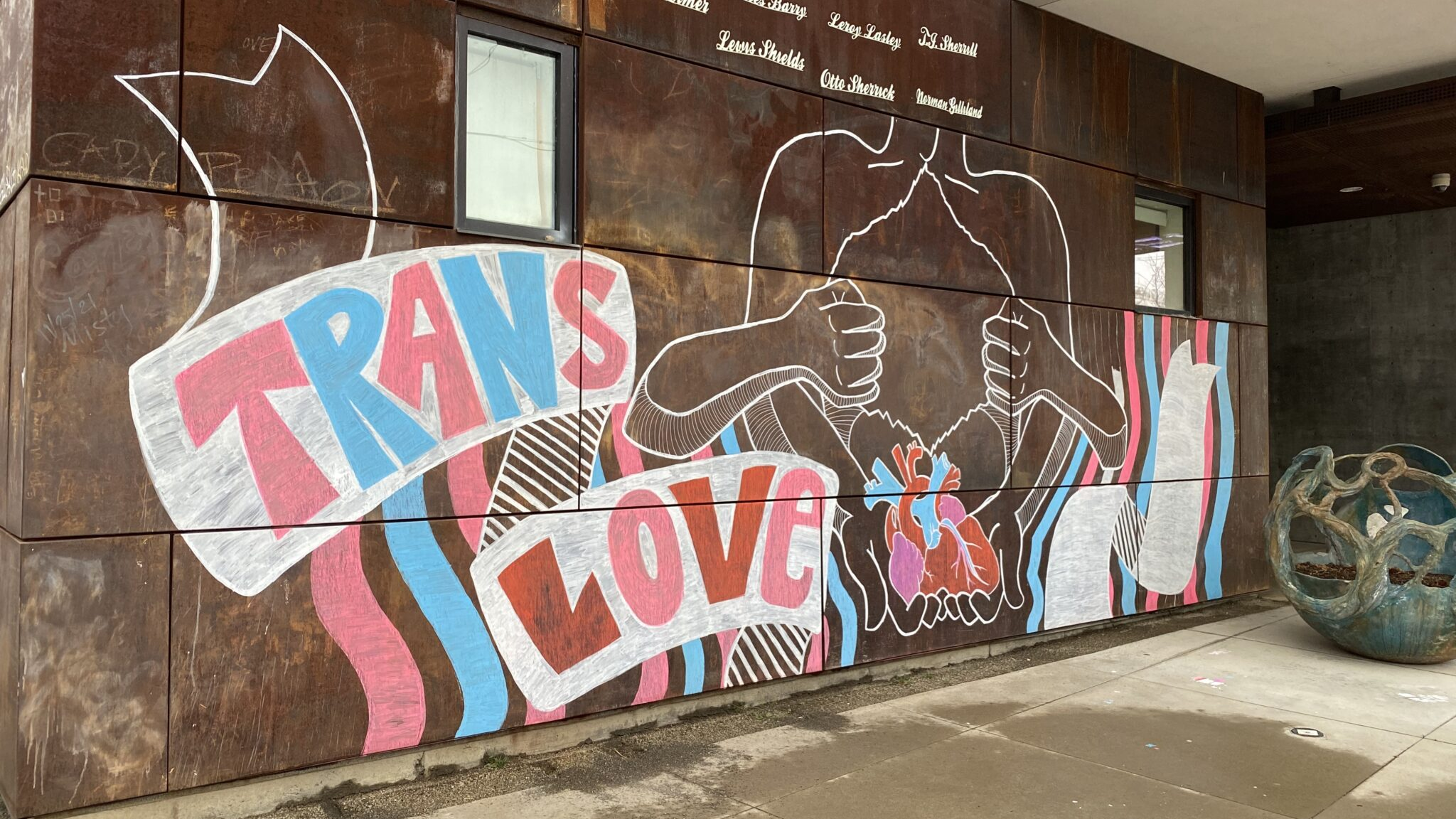
“Not a Rose” by Grace Fallon, Carle Jackson and Lance McMahan, ahha Tulsa

I want you to talk about how much you love trans people. I want you to talk about how important it is to you that trans youth get access to appropriate, life-saving healthcare – especially if you are cis. Bring it up in casual conversation with cisgender people. Put up signs and stickers, or write graffiti tags in your workplace or on the street. Show trans love wherever it’s appropriate, and perhaps especially when it’s not. Transgender people of every age, in every political and social environment, are being bombarded with messages of hostility and injustice at every turn. We hear it from our families, from our elected officials, from our coworkers, and even sometimes our friends. So, turn up the love meter a little bit and be a little bit annoying about how much you love us trans people, even when you don’t think there’s any trans people around. We could really use it.

7. Take care of yourself/your trans loved ones.

Self-care is talked about so often these days that the term can sometimes feel hollow. However, I want to leave this here as a reminder that the most revolutionary thing that we as transgender people can do in this climate is to thrive. If you are a trans person, the most important thing you can do right now is find what nourishes you and cultivate those parts of your life with the support of those around you. If you are not trans yourself, reach out to the trans folks in your life with an offer of care that is meaningful, open-ended, and centering that person’s needs. Maybe what’s wanted is to go for a walk and vent, or to have someone help clean around your apartment. Maybe you’re looking for a buddy to go for a jog with, or to go smash broken pottery with to release some of your rage. Whatever it is you’re looking for, try your best to carve out time that allows for more of what you need to happen, and don’t be afraid to ask for help.

Over the past few weeks, it has been easy for me to slip into despair and feel isolated and afraid for myself and my community. I leave you this list as a way to open up space to imagine a better future for yourself, to find generative energy and creative space within the difficulties we are facing while building authentic connections with those most impacted by the violent anti-trans rhetoric being casually wielded in the public sphere. We cannot give up in this fight for justice, and the tools we choose to defend ourselves will depend on who we are and how we are called into the work. May these suggestions be a springboard for your imagination, and may you push beyond limits to find a path forward that is hopeful, sustainable, and authentic.

If you want up-to-date information on current anti-trans bills and how to take action by contacting legislators, check out the ACLU’s Legislative Map, the National Center for Transgender Equality’s State Action Center and the weekly policy updates from them magazine put together by the fantastic Trans Formations Project (sign up to volunteer with them here!).
Supporting students in transition: Trans Awareness Week 2019

As an out transgender teacher, I often found myself the default person helping coordinate students’ name, pronoun, and gender identity changes at school. This is for several reasons – first of all, I had volunteered to be a resource at school for supporting trans students; I believe that my school would have honored a request to bow out of this work. It’s also true that for teachers with marginalized identities, including trans teachers, students who share those identities tend to gravitate towards us because they see us as people they can trust.

As such, one major reason that I think I often ended up advocating for trans students during times of major change is because I’ve been there before, and it is easy for me to empathize with students about the challenges and frustrations of living in a system that continually refuses to acknowledge that you exist.

So, I want you to imagine for a moment that you are a transgender student in the school you work in preparing to share your identity for the first time. You have likely thought about coming out for weeks, months, or even years before you had the courage to tell a single person what you are going through. As you prepare to share your story with grown ups and students in your life, you likely did hours of research online, getting advice from other trans people about their experiences and comparing them to your own.

Don’t we owe those students the same level of preparation?

Luckily for us, we don’t have to start from scratch. At the Gender Odyssey conference this year, I met Maria Al-Shamma, a social worker who works with LGBTQ middle school students and helps coordinate student transition plans in the San Diego, CA area. Transgender students are explicitly protected in California under AB 1266, the School Success and Opportunity Act. I was really impressed with Al-Shamma’s district-wide student transition plan which acts in accordance with this law – it is clearly laid out and standardized while leaving room for individual students’ needs to be determined by them and their support team. In particular:

  • Students do not need to have a legal name change. Not only is getting a legal name change prohibitively expensive for some students, it is a stressful process that can involve a lot of barriers and unwanted publicity, depending on the state. Finding a way for students to be able to change their functional name at school while maintaining the mandatory legal name records may be a little complicated, but it isn’t impossible.
  • Students can choose to have a gender marker that is not M or F. I actually didn’t see this in the paperwork, but any comprehensive transition plan will include a way for students to have a gender marker in their records that is neither M nor F. This now has official precedence in several states, including my home state of Washington. If the management system you use doesn’t allow for this, ask for it. Consistently. Incessantly. If they don’t change it, make a plan for a new system that can do what you need it to do.
  • A students’ caretakers may or may not be aware of their transition. This is something that a lot of educators, understandably, get concerned about when considering to use a new name and/or pronouns at school – “Does the child’s family know?” In some cases, parents are super supportive and will be excited about their student’s journey. In other cases, students face punishment, abuse, or homelessness because of their identity. Trust students to know when it is safe for them to come out at home. Support them in what they want and need – what a gift that they can be themselves at school regardless of what things are like at home.
  • It doesn’t leave behind a student’s deadname to out them as trans to anyone accessing the system. One thing I really, really appreciate about this plan is that it explicitly prohibits administrators from leaving information in the system that outs students as trans or makes it easier for teachers to make mistakes with deadnames and wrong pronouns. This is especially important for administrators, health and social workers, and substitute teachers who may be encountering a student for the first time (or the first time in a while) and want to affirm their identity. Having the default system be the one where the students’ real and current name and gender marker are present – with nothing else – is essential to supporting this process.
  • It doesn’t assume a one-size-fits-all approach to transition. Every student is different and will want different things with their official records and transcripts. I love that this form asks students about the contingencies and makes a plan for each one of them.

Educators, what have you seen in your schools and districts that works to support students in transition? What would you add as advice to others creating plans for students coming out as trans at school?

Stay tuned for more ideas and suggestions about supporting transgender students after transition and creating schools that help transgender teachers and staff thrive.

Teaching Biology as Anti-Racist Practice: Reflections and Share-outs from Fred Hutch’s Biology and Social Justice Working Session

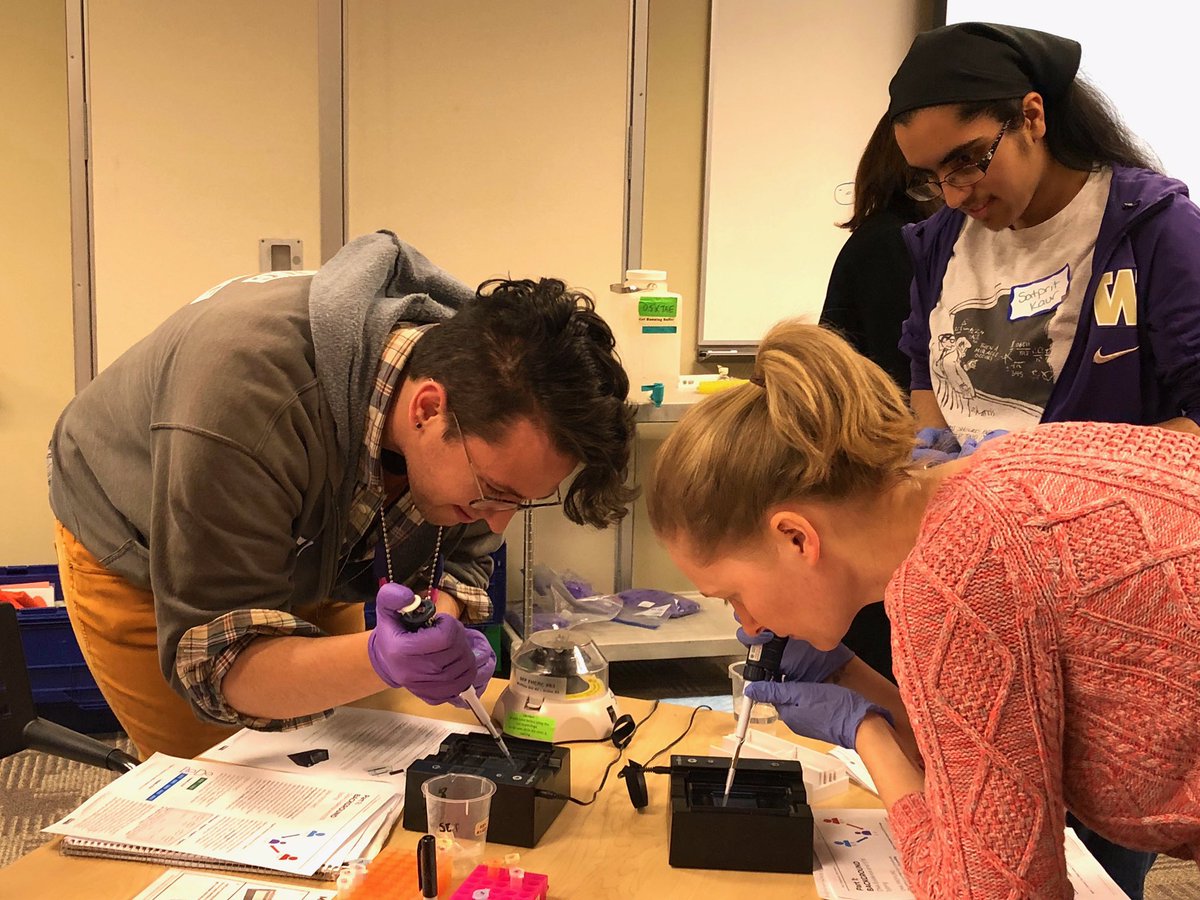
This past weekend, I was lucky enough to participate in a fantastic workshop put on by the Fred Hutch Cancer Research Center’s Science Education Partnership. The day included talks by Brian Donovan, a researcher with BSCS who focuses on humane education and how biology education shapes students’ racially biased beliefs, and Jason Foster, a high school teacher who centers his year-long curriculum around issues of social justice and race. We also did a hands-on lab activity that transformed a typical genomics conviction lab into a framework where DNA testing can be used to exonerate those wrongly convicted of crimes.

Three teachers pipette DNA in an exoneration lab during the Biology and Social Justice Working Session on March 23, 2019

Both during and after this workshop, I repeatedly felt like my brain was on fire with new ideas and reframing how I think about science education in a fundamental way. Here are a few of my main takeaways from the event:

Biology educators have a moral obligation to teach students about race. Several peerreviewed studies have shown that the way genetics and race are taught in biology classrooms has a direct effect on students’ concept of genetic differences between individuals of different races and their ideas of how much of the disparities between racial groups can be explained through biology. This long-lasting misconception has its roots in the early years of evolutionary science, where (overwhelmingly white and male) biologists applied the rules of genetics to justify racist ideologies and practices. That same logic is a critical underpinning of white supremacist arguments used to lure individuals (including children) into their bigoted and violent social movements. It is imperative to use evidence-based practices to displace problematic misconceptions about genetics, race, and inequity from our teaching and replace them with interventions that move students towards accurate ideas of what differences exist between racial groups from a biological and genetic perspective.

Race is a powerful social construct with real and potentially deadly influence on human lives. However, biology does not support the stereotypes and distinctions that society imparts on individuals with different racial and ethnic heritage. I’m not going to linger on this much here, because many others have written or presented on this topic with significantly more expertise than I have. One of the coolest parts of being in this workshop was hearing from biologists and geneticists about the cutting-edge research in this area showing that there is very little genetic diversity in the human race as a whole compared to other species, and that there is more diversity genetically within geographical/racial groups than there are between them. Check out this presentation from the conference (which includes presentation notes for context) and this article for more details on the science behind genetic diversity and variation.

Biology, and science more broadly, can be used for anti-racist means and must be framed as tools of liberation. I have taught about the racist history and modern practices of biology and medicine in my classroom, but it wasn’t until I attended this workshop that I saw the transformational power of using biology itself as a tool for social change. Many labs that I have used in the past can easily be changed into pathways for fighting for social justice. One example, mentioned above, is providing context for how DNA testing can exonerate those wrongfully convicted of crimes, folks who are overwhelmingly Black and Latinx. Mr. James Foster shared about a Daphnia lab (remake of the classic lab used by many biology teachers to demonstrate the effects of stimulants and depressants on heart rate) he does with his students focused on common pollutants that are emitted by local factories. After collecting data on how the Daphnia were affected, students write to factory owners and local politicians to share their data and any concerns they have about the impacts those factories are having on local communities. Unsurprisingly, many affected communities are disproportionately black, brown, and poor compared to surrounding neighborhoods that don’t have factories in them. How many other examples are there of ways to reframe the work we are already doing to provide students an avenue for fighting back against oppressive systems?

Anti-racist teaching practice cannot be handed out in a single curriculum packet, nor is it something you earn as a one-time event. Mr. Foster is often asked if he can provide examples of his lesson plans so that other teachers can implement them in their classrooms. His response is consistently no – from his perspective, teachers must first do their own identity work and find their relationship to anti-racism and social justice in their teaching. Then, they need to be attuned to who their students are and identify their needs as a community. Once this work has begun in a deeper way, they will be able to create their own curriculum that meets the needs of those students in an appropriate, timely, and integrity-based manner. This resonated for me deeply. It is incredibly challenging to create this kind of classroom environment, where identity, oppression, and marginalization are at the center of daily practice. However, there is no “one-size-fits-all” curriculum that could possibly tackle the issues faced by individual communities. I left feeling rejuvenated about the ways that this work is complex, ongoing, and individual to the teachers and students in each classroom community.

Small adjustments can lead to big changes. When asked what his biggest challenges in doing anti-racist biology teaching were, Mr. Foster said that it was always himself. A fear of failure pervaded his thinking and made him afraid of taking the first steps in developing his curriculum. “We are scientists and we must savor the iteration process. If we fail, we should bathe in the idea that we should look at what we did, change what didn’t work, and try again.”

It can be easy to fall into despair at the threat of failure, especially when there seems to be so much work ahead of us as biology educators dedicated to liberation. Some easy first steps to implementing changes in your classroom are providing a disclaimer before using problematic or oversimplified language in lesson plans, textbooks, or media used at your school. Next one can create ways for students to participate actively in driving conversations about identity, race, and lived experiences to shine personal context onto your curricular materials and make them more relevant to those in your classroom community. Beyond that, doing your own research, reading, and deep dive into how to add in new ideas or transform your own materials to be centered around social justice is an exciting adventure.

Overall, I left Saturday’s workshop invigorated and rededicated to connecting anti-racist practices to science education, especially in the biology classroom. If you have materials or ideas to share about how to promote further work in this area, leave them in the comments below!

Trans awareness week: highlighting cissexism and transphobia in anthropology and beyond

taw-2018-main

November 12-19th was Trans Awareness Week, a time set aside to promote the voices and experiences of transgender and gender nonconforming people.  It is a week of celebration and resilience leading up to the long-standing Trans Day of Remembrance (TDOR), a say set aside to remember the many people who have been lost to transphobic violence.  Personally, I like thinking of TDOR as the Trans* Day of Rage and Resilience, both of which highlight the many ways that we as trans folks survive and fight back against the systems designed to endanger us and make our stories invisible.  

This year’s Trans Awareness Week felt especially personal for me as a U.S. resident because of a Trump administration memo that was released earlier this year indicating that they intend to remove protections for transgender people under Title IX, perhaps the most important form of protection for trans people, especially trans youth in schools.  Receiving this news made many people in my community afraid of what the future holds for us, myself included – without federal protection, I could be at risk of losing my job, healthcare, housing, or other rights and freedoms that I currently possess.  It is even scarier for the many people in my community that have other intersecting marginalized identities, especially trans folks of color, trans youth, undocumented trans people, and disabled and sick trans folks.

Most distressingly to me as a science educator, the leaked memo referred to sex verification using “on a biological basis that is clear, grounded in science, objective and administrable,” such as the sex assigned at birth or DNA testing.  Not only is this extremely invasive, it is blatantly inaccurate!  As a science educator, I decided to take one step towards reducing ignorance about both the science of sex* and gender AND the ways that cissexism, transphobia, and interphobia show up in institutions of power over and over and over again. (To read one intersex person’s reaction to this memo, check out the awesome blogger Dr. Cary Gabriel Costello at  “The Intersex Roadshow”!)

Gender unicorn bones

As a wrap-up to my unit on the skeletal system, I created this presentation about the science of intersex experience** and nonbinary identity, both of which are frequently erased by conservatives who assert that science says you are born either male or female, end of story.  As it turns out, science shows that there is incredible diversity in human sex and gender across time and culture.  Moreover, teaching students that sex is either male or female, end of story, is damaging in SO many ways – damaging to intersex students and transgender students whose realities are erased, damaging to cisgender binary-assigned students who believe that upholding cissexism and interphobia is normal and acceptable, and damaging to our collective liberation from science that believes that children are not capable of understanding the full complexity of the diversity of human experience.

The unit was based on a case study by Dr. Alison MacIntosh, who studies ancient bones of female people and compares them to living cisgender women’s bone development.  Strikingly, she was one of the first people to examine female remains with comparisons to living women’s bone density – other studies used cis men’s bone density numbers to determine strength, showing one tendril of the deep-rooted vines of institutional sexism in science.  I think Dr. MacIntosh is a total badass and I am proud to share her work with my students!  I also wanted to talk about the ways that anthropology intersects with cissexism and interphobia, and bone development being a secondary sex characteristic seemed like a perfect place to discuss this.  One example is the rating scale used to determine the sex characteristics of bones in a skeleton in the field, which can sometimes be ambiguous or conflicting, with no guidance for scientists about how to interpret those data. There are also examples of skeletons that demonstrate sexual and gender diversity in ancient cultures, with little attention paid to them beyond tabloid coverage that focuses on spectacle rather than science.  Our trans and intersex ancestors’ history and remains are no doubt present and overlooked or missed because of the ways  that scientists were trained to never expect to find them.

If you want to talk about integrating intersex and nonbinary awareness into your curriculum, please reach out!  I am always excited to network with other educators doing the important work of dismantling the structures of ignorance that support the oppression faced by me and my transgender siblings worldwide – and our intersex family as well.  

*In my presentation to students, I used the term “sex” to describe the physical characteristics of a person’s body that are considered sex characteristics.  In my own life and work with adults, I try to move away from using the word “sex,” especially “biological sex,” because of its ambiguous meaning and its role in transphobia, especially transmisogyny.  Read more about this topic from Julia Serano (Medium) and Mey (Autostraddle)!

**It feels important for me to note here that I am not intersex, and emphasize that the needs of intersex and transgender communities are very different (though many people identify as both intersex and transgender).  I personally believe that destigmatizing intersexuality is an important step towards liberation of all communities who experience body-focused, sexual, and/or gender discrimination, including transgender people among many others.

Fighting impostor syndrome by providing meaningful feedback

Let’s talk for a minute about impostor syndrome.

For any teacher, this phenomenon will be present to some extent, but in STEM it is especially dangerous for female-identified students and students of color.  There are many responses to impostor syndrome, including creating safe community within your institution for underrepresented groups, discussing the challenges facing those who aren’t well-represented in their chosen fields, and decreasing language that activates stereotype threat.

However, one article I read last year by Beth Andres-Beck stood out in its approach to battling stereotype threat: providing clear, direct feedback that is backed up by concrete evidence.  The author writes about working in various coding environments where insufficient feedback (positive or negative) created a vacuum in which the particular coder could insert whatever self-image they wanted: being the best coder in the world, or conversely, being the least qualified coder of all time.

The trap of impostor syndrome in this scenario is that by choosing to believe that you are an unqualified coder but continuing to work as one creates an urgent need to hide whatever it is that you are doing.  This cycle of perpetuating lack of authentic feedback constructs a fragile identity as an impostor – one that even occasional evaluation can’t break through.

“The genius of imposter syndrome is…we don’t have to disregard when we fall short, for such failures fit our internal narrative.  …When we succeed, we can believe it is part of our act.  Look how well I have fooled everyone by doing work they think is good!  …We have trouble accepting real feedback, since any feedback is based on our facade and we “know” better.  Imposter syndrome also brings with it anxiety and shame, preventing us from feeling the thrill of accomplishment when we do succeed.  It robs us of the joy we earn.”

As a teacher reading the article, it was impossible not to wonder how I create such vacuums of authentic feedback in my own assessments.  And when choosing between the three options of self-concept in an environment with insufficient feedback – good science student, bad science student, and bad science student who everyone believes to be a good science student – it is clear from personal experience that the latter two are usually the perspectives taken by my female students and my students of color.

In response, I am trying to collect tools that will enable me to provide detailed feedback to my students, either from me as a teacher or from peer assessment, that is clear, authentic, and non-threatening.  Below I have listed a few possible strategies – if you have other ideas, please chime in!

  • Frequent formative assessment By using formative assessment probes on a regular basis, students will receive feedback about their own learning in a timely, non-threatening manner.  I highly recommend the work done by Page Keeley on FA in both science and mathematics – her book “Science Formative Assessment” was one of the first texts that got me motivated to become a science teacher.
  • Using detailed rubrics Though writing narrative comments are often more specific and useful, having rubrics that link to the targets for a specific assignment makes it easier for teachers to provide detailed feedback on many assignments in a timely, meaningful manner.  Provide rubrics when the assignment is given (not just at the end) and add specific detail so that students understand the goals set for the assignment.  There are great resources on rubrics at the Buck Institute for Education, which focuses on best practices for Project-Based Learning.
  • Anonymous peer assessment & online discussion The “anonymous” piece of this is incredibly important, when it is feasible.  By creating spaces where students can give feedback to each other/engage with each other without knowing the recipient’s identity, they are less likely to base their comments on their concept of the student receiving the feedback.  Especially given that male students are more likely to be rated as “smart” by their classmates, this is incredibly important to the process for everyone involved.  Anonymous online discussions (see STEMming the confidence gap) are also shown to promote comfort for female students and create parity in male and female participation in discussions.
  • Focus on learning targets Instead of highlighting how smart a student is or their effort, provide feedback specific to the learning targets of the assignment.  Frame your feedback as how the student is or is not meeting the goals of the assignment or unit, and if there is a gap, how it can be successfully bridged by the student.  This is a natural outcropping of standards-based grading, which many schools and districts have adapted more and more to provide more meaningful, learning-focused assessment to students.

What ideas do you have to add to this list?  Other thoughts on fighting impostor syndrome?  Leave them in the comments!